The second element in the periodic table and the lightest noble gas.
Helium explained
What is helium?
Helium is a light, colourless, odourless and non-flammable noble gas. Its low density, chemical inertness and extremely low boiling point make it valuable in healthcare, science and industry.
The element
Helium in brief.
Helium has the chemical symbol He and atomic number 2. Its full outer electron shell makes it very unreactive, which is why helium belongs to the noble gases.
At normal temperature and pressure helium is a gas. It is much less dense than air, does not burn and does not itself support combustion. Helium is not the same as hydrogen: hydrogen is also light, but is flammable.
Liquid helium supports cooling to extremely low temperatures.
Under normal conditions helium hardly reacts with other substances.
This is why a correctly filled helium balloon can rise.
Origin and production
Where does helium come from?
Helium on Earth is mainly formed by radioactive decay in rock. It can migrate through geological layers and accumulate in underground reservoirs. Because helium is small and light, some eventually escapes from the atmosphere into space.
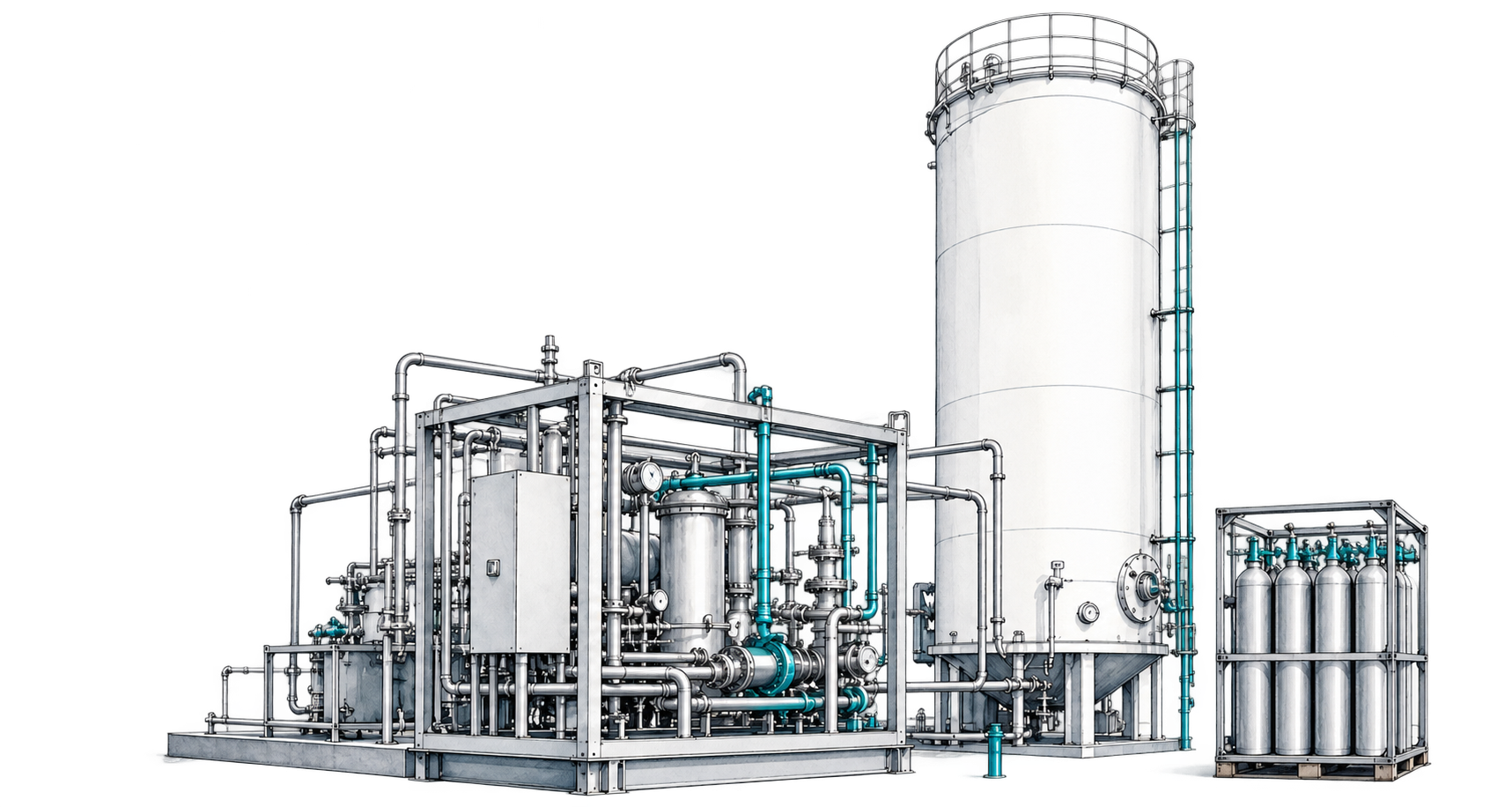
Commercial production separates helium from a helium-bearing gas stream and purifies it. It can then be distributed as compressed gas in cylinders or bundles, or liquefied for cryogenic applications.
View the map of sources and projects →Formation
Helium forms slowly in rock.
Extraction
Helium-bearing gas is brought to the surface.
Purification
Other components are removed to meet the product specification.
Distribution
Supply is gaseous or liquid, depending on application and volume.
What is helium used for?
From MRI to leak detection.
The combination of low temperature, low density and low reactivity determines where helium is used.
MRI and magnets
Liquid helium can keep superconducting magnets at a very low temperature.
Laboratory analysis
Helium is used as a carrier gas in gas chromatography and GC-MS.
Leak detection
Small atoms and sensitive detection make helium useful as a tracer gas.
Industry and process gas
Helium can serve as an inert process, purge or pressure gas.
Welding
Helium is used as shielding gas or in specialist welding mixtures.
Diving mixtures
Helium can form part of professionally prepared Heliox and Trimix.
Balloons
Because it is less dense than air, helium can make balloons float.
Science and cryogenics
Research uses include experiments, vacuum technology and cooling systems.
Quality and specification
Helium 4.6, 5.0 and 6.0.
The grade states minimum total purity: 4.6 means 99.996%, 5.0 means 99.999% and 6.0 means 99.9999% helium. Equipment and process requirements determine the correct grade and impurity limits.
Balloon helium is an application grade and does not automatically have a universal 4.6, 5.0 or 6.0 classification.